Free Memorial Day Coloring Pages for Kids: Family Conversation Starters, Backyard Activities, and a Gentle K-3 History Explainer
Printable Memorial Day coloring pages for kids, plus a gentle one-minute history explainer, easy backyard picnic activities, and a quiet family tradition you can start this Monday.
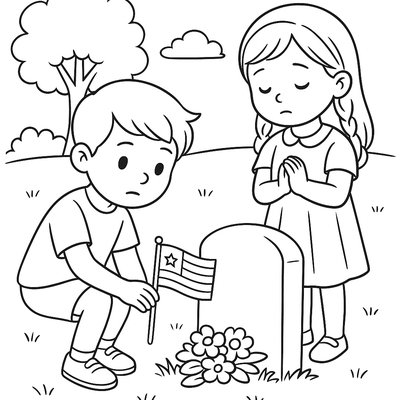
Memorial Day weekend is one of the trickier American holidays to share with young children. The cookout part is easy. The pool-opening, the long weekend, the lazy Monday — kids understand all of that. The remembering part is harder. Most parents I know hit the same wall every year around this time: how do you tell a six-year-old what the day is for without either skipping the meaning entirely or saying something too heavy for a kid who's still learning to read?
What's worked for our family, and for a lot of the educators who use ColorNest, is a small physical activity tied to a single short sentence. A coloring page in their hands and one honest line from an adult. Nothing more. The page gives them something to do with their hands while the idea quietly lands. Below are the free patriotic-holidays coloring pages we use in our house on Memorial Day weekend, plus a few backyard and picnic pages to round out the day, and the gentle one-minute explainer that's worked best with kids in the K-3 stretch.
What Memorial Day Actually Is — a One-Minute Explainer for Kids
The most useful sentence I've ever borrowed from a kindergarten teacher for this day is some version of: "Memorial Day is a quiet holiday in the middle of a noisy weekend. It's the day we remember the people in the military who didn't come home." That's it. That sentence has done more work in our house than every documentary or news clip combined, because it gives a young child two things at once — a fact they can hold and an instruction for how to feel about it.
If your child asks a follow-up, the best follow-up I've heard is also short: "We don't have to be sad all day. We just take a quiet minute to remember." Five-year-olds and seven-year-olds can do quiet minutes. They can't do thirty-minute lectures on the history of American wars, and most of us can't either. The day works better as a single thoughtful pause inside a normal family weekend than as a project.
If you want a tiny bit more vocabulary for older kids — a confident first or second grader, say — Memorial Day was first widely observed after the Civil War, became an official federal holiday in 1971, and is observed on the last Monday of May every year. (In 2026 that's Monday, May 25.) Veterans Day, in November, is the holiday for thanking living veterans for their service — different day, different purpose. Kids often mix the two up; it's worth gently naming the difference once and then letting it land. There's a short, accurate explainer at the National Cemetery Administration's page on the history of Memorial Day if a curious older child wants to read more on their own.
For families who want a true grown-up-level recap to anchor their own understanding before the conversation, the History.com overview of Memorial Day is a clear, short read. Skim it once and you'll have everything you need to answer kid-sized questions for the rest of the weekend.
A Few Coloring Pages to Anchor a Small, Real Moment
The two pages I print every year, because they ground the day in something a child can actually picture, are both in the ColorNest patriotic-holidays subcategory. They aren't dramatic. They aren't sad. They show kids doing the small, recognizable thing that's at the center of the holiday — placing a flag.
- Two children respectfully placing a small flag at a memorial marker. The single most useful Memorial Day coloring page we've ever printed. It shows kids who look the same age as your kid doing the exact thing the day is for. No abstract symbols, no battle imagery, no flags-waving-in-fields drama — just two children, a marker, a small flag. Coloring it usually opens the door for a quiet question or two without forcing one.
- Children placing small flags at a veteran's memorial in a park. A slightly wider scene — same idea, more space for crayons. Pair it with the first page, or print one for each child if you have siblings who want their own.
We pair those two with one or two adjacent pages that give the day a little breathing room and let coloring time stretch past the heavy beat. The combinations that have worked best in our house:
- A bouquet of flowers or a field of blooming tulips and daffodils from the flowers and gardens collection. Memorial Day is also called Decoration Day in older parts of the country because of the tradition of bringing flowers to cemeteries; pages from the nature flowers library are a quiet, unforced way to connect the coloring to that tradition.
- A park ranger teaching children about wildlife or a mail carrier delivering letters from the community helpers coloring pages. Memorial Day is specifically about military service, but the broader idea — adults who do hard jobs that keep others safe — lands well with K-3 kids if a parent wants to expand the conversation slightly. The educational community helpers set covers a similar idea with a slightly more classroom-friendly tone if you want both flavors on hand.
- A page from emergency vehicles at work for kids who relate to service through vehicles more than people — fire trucks, ambulances, the recognizable equipment of jobs that keep neighborhoods safe.
If your child is in the K-1 range, two coloring pages and one sentence is the entire activity. Don't add more. They've absorbed what they can absorb. The page goes on the fridge or in the keepsake folder; the moment is done.
How to Talk About Service and Loss Without Overwhelming a Young Kid
The question that gives parents the most trouble — every year, in our house and in every parent group I've ever lurked in — is the one that comes after the one-sentence explainer. Some version of "did people die?" or "do soldiers die now?" Some version of "could that happen to someone in our family?" These are honest questions and they deserve honest answers, calibrated to age.
What's worked best for us is a single principle: answer the question they asked, not the one you think they might be asking. A five-year-old asking "did people die" is usually checking a fact, not asking for a casualty count. "Yes, sometimes people in the military don't come home, and that's the thing this day is for" is enough. They'll move on, or they'll ask another question. If they ask another question, answer that one too.
Two phrases that have worked across our kids and several of our friends' kids:
- "We don't have to be sad all day. We just take a quiet minute to remember."
- "Most people in the military do come home. We're remembering the ones who didn't."
Both are true. Both are calibrated to a young child's sense of safety. Neither asks the child to carry the full weight of what the day historically means — that's an adult job. If your child has a relative in the military, you'll have your own version of this conversation, and you already know your family's context better than any blog post does. For everyone else, brief and steady is the right register.
If your child's questions get bigger or sadder than feels right for the moment, the calm and relaxation coloring pages in our emotions and mindfulness collection are useful to have on the table. We've also written more on the everyday version of this elsewhere — why coloring is a good quiet-time anchor for busy families is the one we re-share most often when a parent friend asks how to do this kind of moment without flooding it with words.
Backyard, Park, and Picnic Activities to Pair With the Pages
Memorial Day weekend is also the weekend a lot of American families start their summer. The cookout, the first swim, the first long-light evening on the porch — these aren't a contradiction to the meaning of the day, they're the texture of the country the day is for. Most families do both at once, and that's the right thing to do.
A few coloring-page pairings that keep kids busy in the bookends of the weekend without making the activity feel like homework:
- The picnic foods coloring pages — a family picnic spread with fresh spring salads and sandwiches, watermelon slices on a picnic table, or an outdoor barbecue with corn on the cob — print a stack and bring them to the cookout. They keep kids at the picnic table for an extra fifteen minutes when the food's not quite ready and the adults are still chopping.
- The playground and indoor games coloring pages — children flying colorful kites in a park, kids playing tag in a park, or the wider scene of children playing on a playground with swings and slides — for kids who'd rather do the thing than draw the thing, these double as a "let's go" suggestion. The page becomes the agenda for the next hour.
- A page or two from adventure landscapes for families heading out of town — a camping scene with a tent, campfire, and stars or a mountain trail with a waterfall and wildlife. Pages travel well; they're quiet on the drive, and they give kids something to do at the campsite without screens.
Tuck a folded page or two into the picnic basket alongside the napkins. Most kids will color one between the burger and the watermelon, which is exactly the right amount of structure for an unstructured weekend day.
A Small Family Tradition Worth Starting: the Walk, the Flag, the Page
The single best Memorial Day tradition I've stolen from other families, and the one we now do every year, is a Monday-morning walk to the closest cemetery, veterans memorial, or town green. Most American towns have one. The walk is fifteen to forty minutes round-trip depending on where you live. You bring a small American flag from the hardware store or the supermarket — they sell them in bundles of ten this time of year for under five dollars — and your child gets to place it somewhere appropriate. A grave marker, a memorial wall, the base of a flagpole. If you're not sure what's appropriate at your local site, you can ask. Cemetery staff and parks departments are unfailingly kind about explaining what's welcome.
The whole walk doesn't take much narration. The walk itself is most of the lesson. You're outside, you're together, and at the end of it your child placed a small thing in a quiet place because the day asked them to. That's a tradition that doesn't need a sermon.
When you get home, the coloring page is waiting. The child placing a flag at a memorial marker page now has a real-life referent — your child did exactly that thing an hour ago. Coloring it becomes a way of remembering not just the holiday but the specific small moment they just lived. Stick it in a folder or a keepsake box and pull it out next May, and the tradition starts to compound.
If a walk doesn't work for your family — a baby's nap schedule, a long drive, a thunderstorm — a single quiet minute on the back porch at noon does the same thing. The form matters less than the fact that you marked it.
For Educators: A Short Memorial-Day Anchor That Respects the Day
If you're a teacher, a homeschooler, or a children's-program leader running the last week of May, the same logic that works at home works in a classroom. A short anchor — one sentence, one page, one quiet moment — does more than an elaborate lesson plan. Memorial Day falls inside the last week of school stretch for many districts, which is already a hectic, transition-heavy time; you don't need to add a unit. You need a short, respectful pause.
Two practical setups that work:
- Five-minute morning meeting anchor. Print one patriotic-holidays coloring page per student before the Friday before Memorial Day. During the morning meeting, share the one-sentence explainer from earlier in this post — adapted in your own voice — and give students five minutes of quiet coloring. No discussion required. Some students will ask questions; answer those. Some won't; let them color in silence. That's the whole anchor.
- Lesson tied to the broader social-studies arc. For older K-3 classrooms doing a unit on community helpers, history and social studies, or holidays and celebrations, Memorial Day fits cleanly between Mother's Day (covered well in our Mother's Day and Teacher Appreciation Week post) and the end-of-year stretch. You can find supporting pages in the teacher bundles May learning activities set or, for the final-week-of-school transition, the end-of-year and summer bundle.
A few classroom teachers we work with have shared that the simplest version — print one page, two minutes of context, five minutes of coloring, send home in the take-home folder — gets a better response from parents than any of the more elaborate Memorial Day activities they've tried. It's calibrated to what the day asks for: brief, real, finishable.
For more on the underlying principle — that a single coloring page can be a meaningful anchor for a heavy or distracting day — our piece on pairing coloring pages with literacy and social-emotional lessons gets at the same idea from a different angle. And if you're already running an outdoor classroom routine, a flag-placement walk at the schoolyard's nearest war memorial or veterans park slots in without disrupting the rest of your week.
Why Coloring Holds Up as the Right Activity for a Day Like This
There's a reason coloring keeps coming back as the default activity for any holiday that asks something a little hard of kids. A child holding a crayon and filling a shape is calmer in their body than a child being asked to sit and listen. The repetitive motion is regulating, the choice of color is theirs, and the small finished page becomes proof that they participated in the day — not just that the day happened around them.
This is also why coloring pages outperform flashcards, worksheets, or short videos as a way to land a single small fact. A page is finishable. There's no quiz at the end. There's no level to fail. A child colors it, hands it over, and moves on, and the fact — "this is what Memorial Day is for" — comes along with the page when it gets stuck on the fridge or tucked into the take-home folder. For more on the research behind why hands-on, low-pressure activities help kids regulate around big or unfamiliar ideas, the American Academy of Pediatrics writes broadly about the role of play in early childhood development, and most of what they cover applies directly to a coloring page at the kitchen table.
Coloring also has the rare property of working as either an individual activity or a family one. If you want fifteen minutes of quiet, that's there. If you want to sit down with your kid and color the page next to them while the rest of the meal cooks, that's also there. Both versions of the moment count. Both versions are the activity working.
For families who want to extend the moment into a small project, a crafting and making coloring page plus a sheet of construction paper turns the coloring into a hand-folded card a child can give to a grandparent who served, or leave at a veterans memorial during a walk. We've covered the parent side of "what to actually do when your kid is wired and needs to land" in screen-free activities that actually keep kids busy, and most of what's in that post applies here.
A Note on Tradition and Inclusion
Memorial Day is an American holiday. Plenty of families in your child's class — especially in more diverse neighborhoods or in classrooms with new-American families — won't have a direct relationship to the US military, and may not want their child to. Some families come from places where military service has a different cultural meaning. Some families are deliberately raising kids without a strong national-symbol vocabulary.
The version of the activity that's worked best across that range is the broader frame: Memorial Day is one of America's days for thinking about people who served, and there are equivalent days in every country and culture for remembering people who gave something up so others could be safe. From that frame, the coloring page becomes less about flags and more about the small physical act of remembering — placing a flower, marking a quiet minute, drawing a picture of someone you want to honor. Pages from the flowers and gardens collection or the may-day coloring set, which centers on spring and renewal, work for families who want to mark the moment without flag imagery.
The point is that the day asks for a quiet pause. The form the pause takes can be calibrated to your family's actual relationship to the holiday, and there's a coloring page for almost any version of it.
Frequently Asked Questions
What age can you start talking to a kid about Memorial Day?
Most preschoolers — around 3 to 4 — can hold a one-sentence version like "It's a day we remember people in the military who didn't come home." They won't grasp the full meaning, and that's fine; you're laying the vocabulary, not delivering a lecture. By 5 to 7, kids can hold the slightly fuller version — the difference between Memorial Day (people who didn't come home) and Veterans Day (thanking living veterans) — and they often ask thoughtful follow-up questions. Answer the question they asked, in one or two sentences, and let them lead the rest.
Are Memorial Day coloring pages free on ColorNest?
Yes. Every coloring page in the patriotic-holidays collection is free to download and print, no account required. The same is true for the broader holidays library, the nature and places sections, and the rest of the 3,400+ free pages on the site. If you want a quick starter bundle for the weekend, the free pack is a hand-curated set you can download in one click.
What's the difference between Memorial Day and Veterans Day?
Memorial Day, observed the last Monday of May, remembers members of the US military who died in service. Veterans Day, observed November 11, honors all veterans — living and deceased, in all eras of service. Both are federal holidays in the United States. Kids often mix the two up; it's worth gently naming the difference once and then letting it land naturally over a few years.
What's a good activity to pair with a Memorial Day coloring page?
A short walk to a local cemetery, veterans memorial, or town green, with a small flag your child can place. The walk itself is most of the lesson. When you get home, color the child placing a flag at a memorial marker page together — the coloring becomes a way of remembering the small real-life moment they just had. Keep it in a folder and the tradition compounds year over year.
Can I make a custom Memorial Day coloring page for my child?
Yes — ColorNest's AI coloring page generator can produce a custom page from a short text prompt or a family photo, which is useful if you want to depict a specific scene (a grandparent who served, a particular memorial, a child's own idea). A few free generations are included with a ColorNest account, and custom coloring books are available if you want to print a small keepsake book for a family member.
How do educators use Memorial Day coloring pages in the classroom?
The version we hear works best is the brief one: one page per student, one sentence of context, five minutes of quiet coloring, sent home in the take-home folder. For broader social-studies units, the history and social studies coloring pages and the teacher bundles May learning activities set pair well with a Memorial Day anchor. The free classroom pack is a curated download for teachers who want one bundle to print and run.
The bottom line
Memorial Day at home doesn't need a project. It needs a small, real pause inside an otherwise normal weekend. One sentence, one page, one quiet minute. A walk if you can manage it, a porch sit if you can't. The coloring page is the anchor — it gives a child something to do with their hands while a small idea about service and remembering quietly lands, and it produces a small finished thing they can keep.
If you want a stack of pages ready for Monday morning, you can browse the patriotic-holidays collection on ColorNest and print them in one batch tonight. For educators, the teachers' page and the free classroom pack cover the rest. Whatever shape your family's version of the day takes — the picnic, the walk, the quiet porch sit — the activity that holds it together is almost always the same: a child, a page, and an honest sentence from a grown-up they trust.